Particle Swarm Optimization
Overview
Particle Swarm Optimization (PSO) is a population-based evolutionary optimization technique inspired by the collective behavior observed in natural swarms such as birds flocking or fish schooling. Similar in spirit to Genetic Algorithms, PSO operates on a swarm of candidate solutions, called particles, which collaboratively search the design space for an optimal solution.
Each particle represents a potential solution and moves through the search space by updating its velocity and position based on:
- its own historical best position (personal best, (\(P_{best}\))), and
- the best position discovered by the entire swarm (global best, (\(P_g\))).
In this project, PSO is visualized using p5.js to provide an intuitive understanding of how particles explore the search space and converge toward an optimum.
Optimization Problem
Let the objective function be
\[ \min f(x, y) = x^2 + y^2 \]
This is a simple convex function with a global minimum at ((0, 0)). The goal of the swarm is to iteratively move particles toward this point.
Particle Representation
PSO begins by initializing a swarm of particles with random positions and velocities. Each particle maintains:
- its current position and velocity,
- its personal best position encountered so far, and
- the corresponding fitness value.
In the visualization, each particle is rendered as a small circle. The particle object in JavaScript is shown below. Positions and velocities are initialized randomly within the search domain.
class Particle {
  constructor() {
    this.pos = createVector(random(-200, 200), random(-150, 150));
    this.vel = p5.Vector.random2D().mult(2);
    this.best = this.pos.copy();
    this.bestVal = this.pos.x ** 2 + this.pos.y ** 2;
  }
...
show() {
    stroke(255);
    fill(255, 150);
    ellipse(this.pos.x, this.pos.y, 6, 6);
  }
Swarm Initialization
A swarm consisting of (n) particles is created during the setup phase. At initialization, the fitness of each particle is evaluated, and the global best solution across the swarm is identified.
let n = 30;
let particles = [];
let gBest; // global best position
let gBestVal = Infinity;

function setup() {
  createCanvas(600, 400);
  for (let i = 0; i < n; i++) {
    let p = new Particle();
    particles.push(p);

    // Evaluate initial fitness
    let val = p.pos.x ** 2 + p.pos.y ** 2;
    // Update global best
    if (val < gBestVal) {
      gBestVal = val;
      gBest = p.pos.copy();
    }
  }
}
PSO Update Equations
The motion of each particle is governed by the following update equations:
\[ v_{id}(t+1) = w v_{id}(t) + c_1 r_1 (p_{id} - x_{id}(t)) + c_2 r_2 (p_{gd} - x_{id}(t)) \]
\[ x_{id}(t+1) = x_{id}(t) + v_{id}(t+1) \]
where
\[ \begin{aligned} w &= \text{inertia weight} \\ c_1 &= \text{cognitive coefficient} \\ c_2 &= \text{social coefficient} \\ r_1, r_2 &\in [0, 1] \text{ are random numbers} \\ v_{id}(t) &= \text{velocity of particle } i \text{ at iteration } t \\ x_{id}(t) &= \text{position of particle } i \text{ at iteration } t \\ p_{id} &= \text{personal best of particle } i \\ p_{gd} &= \text{global best of the swarm} \end{aligned} \]
Here, (\(i\)) denotes the particle index, (\(d\)) represents the dimensionality of the problem, and (\(t\)) is the iteration counter.
Particle Update Logic
Within the Particle object, the update() method implements the PSO equations. The inertia term controls exploration, while the cognitive and social terms guide particles toward promising regions identified by individual and collective experience.
...
update() {
    // PSO parameters
    let w = 0.5; // inertia
    let c1 = 1.0; // cognitive
    let c2 = 1.0; // social

    // velocity update
    let r1 = random();
    let r2 = random();

    // Make sure gBest exists before using it
    if (gBest) {
      let cognitive = p5.Vector.sub(this.best, this.pos).mult(c1 * r1);
      let social = p5.Vector.sub(gBest, this.pos).mult(c2 * r2);
      this.vel.mult(w).add(cognitive).add(social);
    }

    // position update
    this.vel.mult(0.01)
    this.pos.add(this.vel);
  }
Iterative Optimization and Visualization
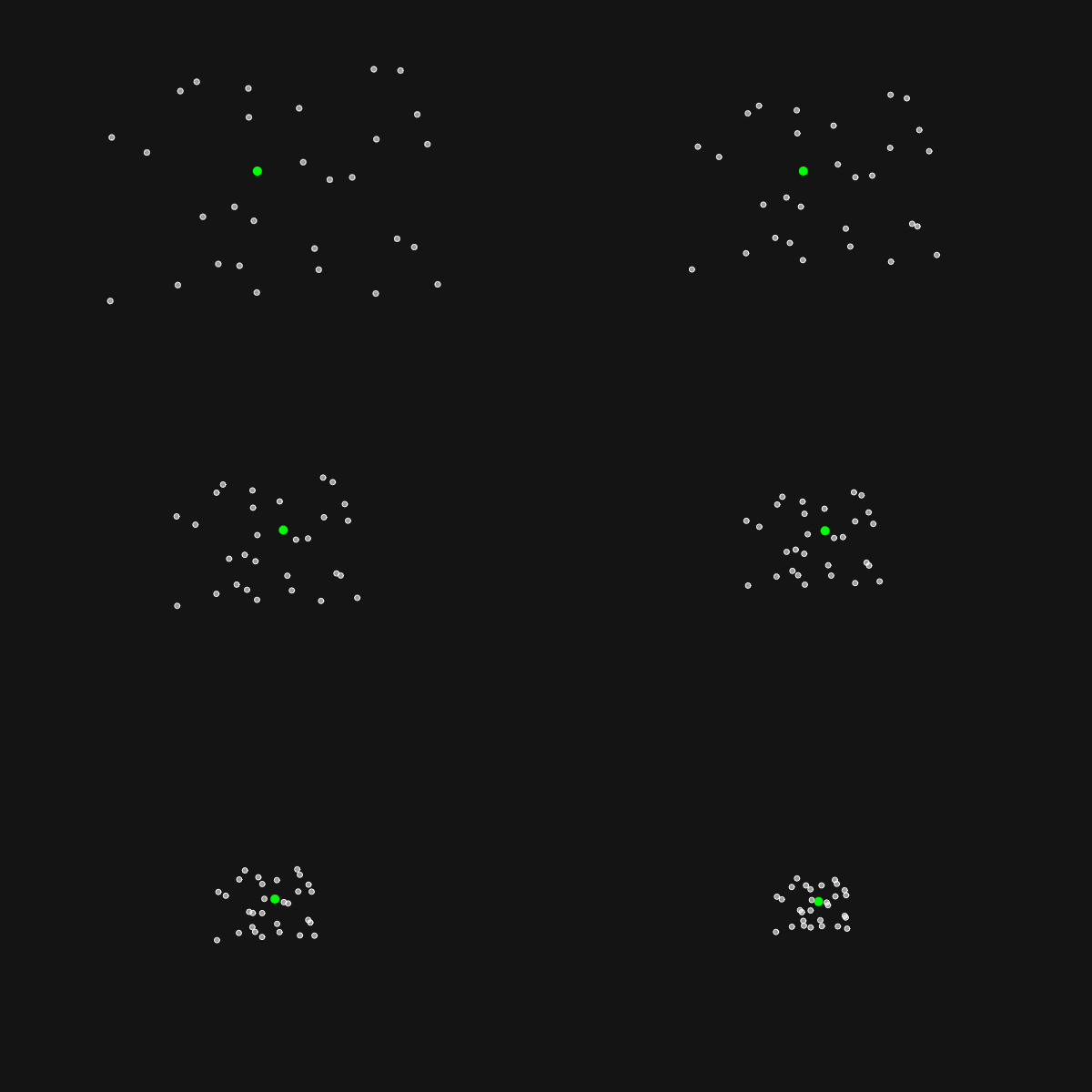
During each animation frame, particle positions are updated, fitness values are evaluated, and both personal and global bests are revised. The global best position is highlighted in green to visually distinguish it from the rest of the swarm.
function draw() {
  background(20);
  translate(width / 2, height / 2); // origin at center

  // Evaluate and update all particles
  for (let p of particles) {
    p.update();
    p.show();

    let val = p.pos.x ** 2 + p.pos.y ** 2;
    if (val < p.bestVal) {
      p.bestVal = val;
      p.best = p.pos.copy();
    }

    if (val < gBestVal) {
      gBestVal = val;
      gBest = p.pos.copy();
    }
  }

  // Draw global best
  noStroke();
  fill(0, 255, 0);
  ellipse(gBest.x, gBest.y, 10, 10);
}
Results
As the simulation runs, particles gradually converge toward the origin, demonstrating the collective optimization behavior of PSO. The animated result is shown below.
The complete p5.js sketch can be accessed at the following link: PSO Visualization on p5.js Editor
References
- D. K. Pratihar, Soft Computing, Narosa Publications, New Delhi, 2008